 Getty ImagesSave this storySave this story
In 2022, Karol G stepped onto the Coachella stage for the first time: blue hair, thick black eyeliner, a pair of oversized hoops. Her nails, short but deliberate, were painted in the colors of the Colombian flag. At the time, the world was still getting to know Carolina Giraldo: now the first woman to debut a Spanish-language album at No. 1 on the Billboard 200, and the first Latina artist to achieve one of the highest-grossing tours in history. These are just a few milestones that have made her momentum impossible to ignore.
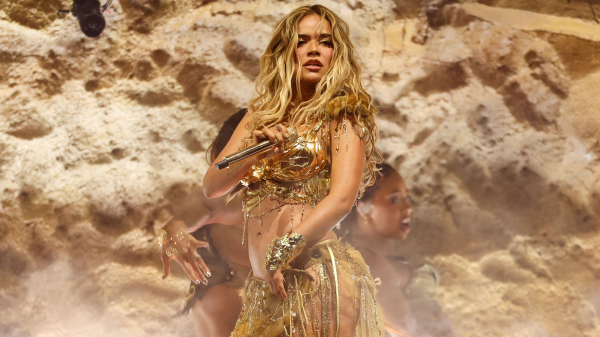
Four years later, Karol G returned to Coachella not as a newcomer, but as the first Latina to headline the festival in its 27-year run, a shift that feels like both a career milestone and a cultural reorientation. Choreographed by Parris Goebel—whose work has shaped the stage presence of some of the world’s most powerful female artists, including Shakira, Rihanna, Janet Jackson, and Ariana Grande—this performance became both an offering and a declaration.
 Getty Images
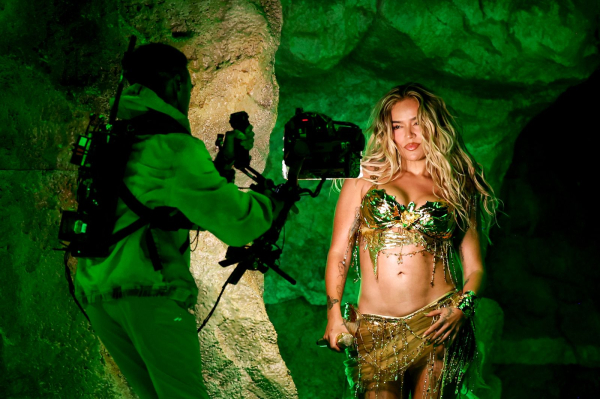
Her set opened with an animated folktale: a girl chosen, then transformed into a woman through surrender. Narrating, Karol G described her as “free, untamable, and wild.” Animals taught her to run and fly, rivers taught her to feel, and mountains taught her to stand firm. The allegory was clear, but not heavy-handed. It gestured toward land, lineage, and the long arc of migration from Medellín, Colombia, to the global stage, while subtly invoking the political realities shaping Latino identity in the US today. The story closed on a powerful message: Forever free.
The story closed on a powerful message: Forever free.
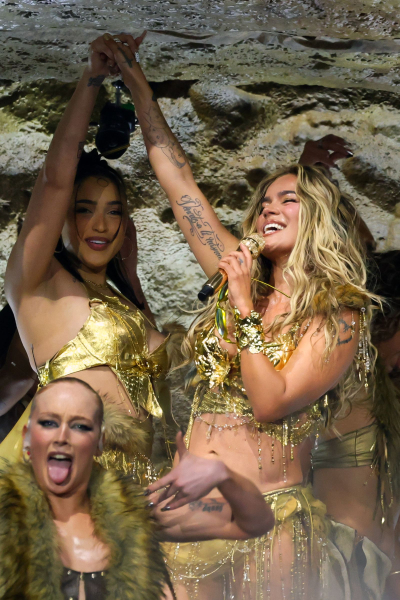
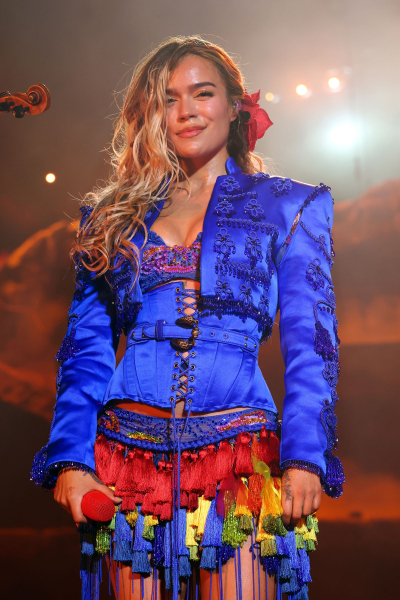
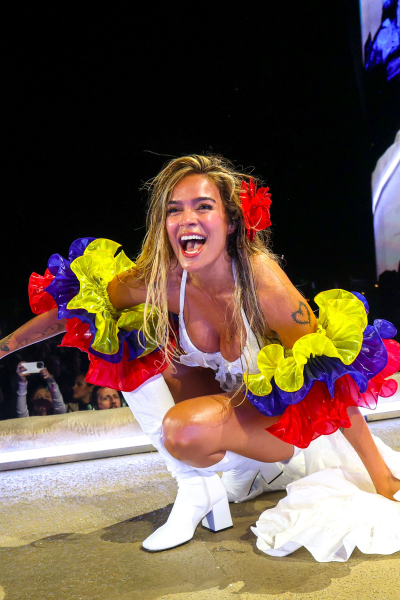
What followed was less a concert than living proof of that freedom. Karol G appeared almost stripped back, her golden-blonde hair worn in effortless, undone waves, styled by Cesar Deleon Ramirez. Her makeup, by artist Duvan Foronda, enhanced rather than exaggerated. Her skin radiated light on stage, with a hint of golden shimmer on the eyes, a barely there lip, and no dramatic eyeliner. It was a stark departure from her 2022 self, and perhaps the most radical choice of all. For an artist whose image has been as fluid as her sound, cycling through red, pink, and electric blue hair, this restraint read as power. She no longer needs the armor.
 Getty Images
 Kim Truong
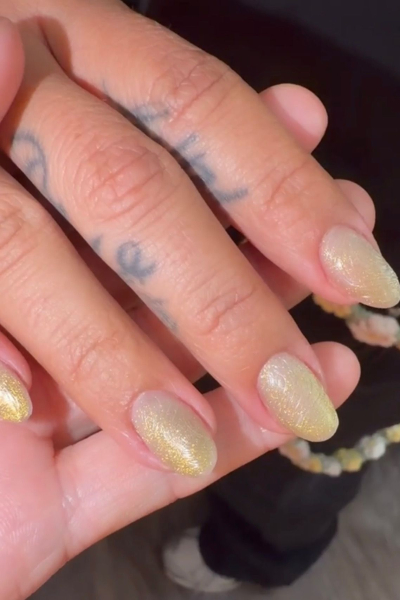
Karol’s manicure mimicked her golden complexion and shimmer-flecked lids. “We wanted something that felt as dynamic as Karol onstage,” says nail artist Kim Truong. “Her golden opening look was the perfect starting point, and the Olive & June Nail Polish in Golden Velvet caught the light in such a beautiful way, and adding texture gave it that extra dimension. It feels elevated but still cool and unexpected, and it transitioned seamlessly through all her outfit changes.” Truong adds that the look was meant to feel “dimensional” and “reflective.” It signals an evolution from her earlier Coachella days, when her identity was expressed more directly, down to the smallest details.
What unfolded through the night resisted the expected cadence of reinvention. There were no dramatic beauty shifts. Even as she moved through water mid-set, hair undone and untouched, the look held. It felt like continuity over spectacle, presence over transformation, a woman fully herself—bare, raw, wild, and unapologetic.
 Getty Images
 Getty Images
Musically, however, she traversed a continent. The setlist became a map tracing Latin America: Reggaeton bleeding into mariachi, then salsa, merengue, Brazilian funk, and mambo, each genre less a detour than a reclamation. It was not a singular Latin identity, but a multiplicity rendered in rhythm.
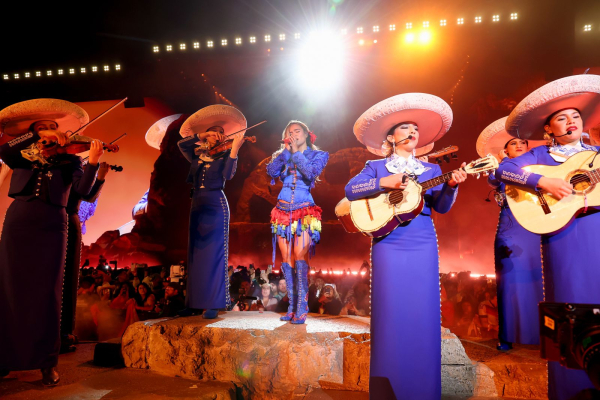
And still, she resisted the obvious. In the mariachi segment, there was no bold red lip, no nod to the archetype immortalized by women like Selena Quintanilla. Instead, Karol G remained intentionally understated, almost neutral, a canvas rather than a character.
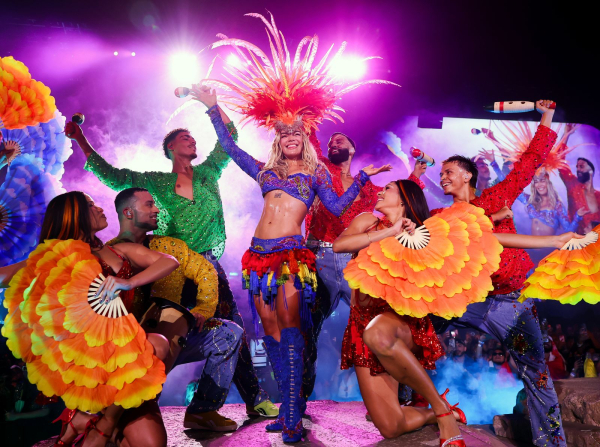
It was the dancers who carried the beauty of the performance, expanding it outward, playing freely with hair and makeup in ways that felt alive. Dancers took to the stage with cheetah-print shaved heads, mohawks punctuated by bright colors and highlighted tips, as well as braids, long extensions, and even bare heads, each one a study in self-definition.
 Getty Images
Studded eyelids and bold lips caught the stage lights beneath the wide brims of the all-female mariachi band—the first of its kind in the US—while flashes of pink hair peeked through, signifying subtle rebellions against tradition. It embodied the tension and beauty of women carving space within historically male-dominated forms, honoring while reshaping them.
Together, they pushed womanhood and Latinidad past a singular aesthetic into something plural. Karol G, at the center, did something quieter: She receded just enough to let the collective rise. The message landed without force: She is in an era of self-possession, not belonging to a man, a genre, or a singular image, but fully, expansively, to herself. And in doing so, she extended that permission outward.
 Getty Images
Leave a Reply